by Helen Ksypka
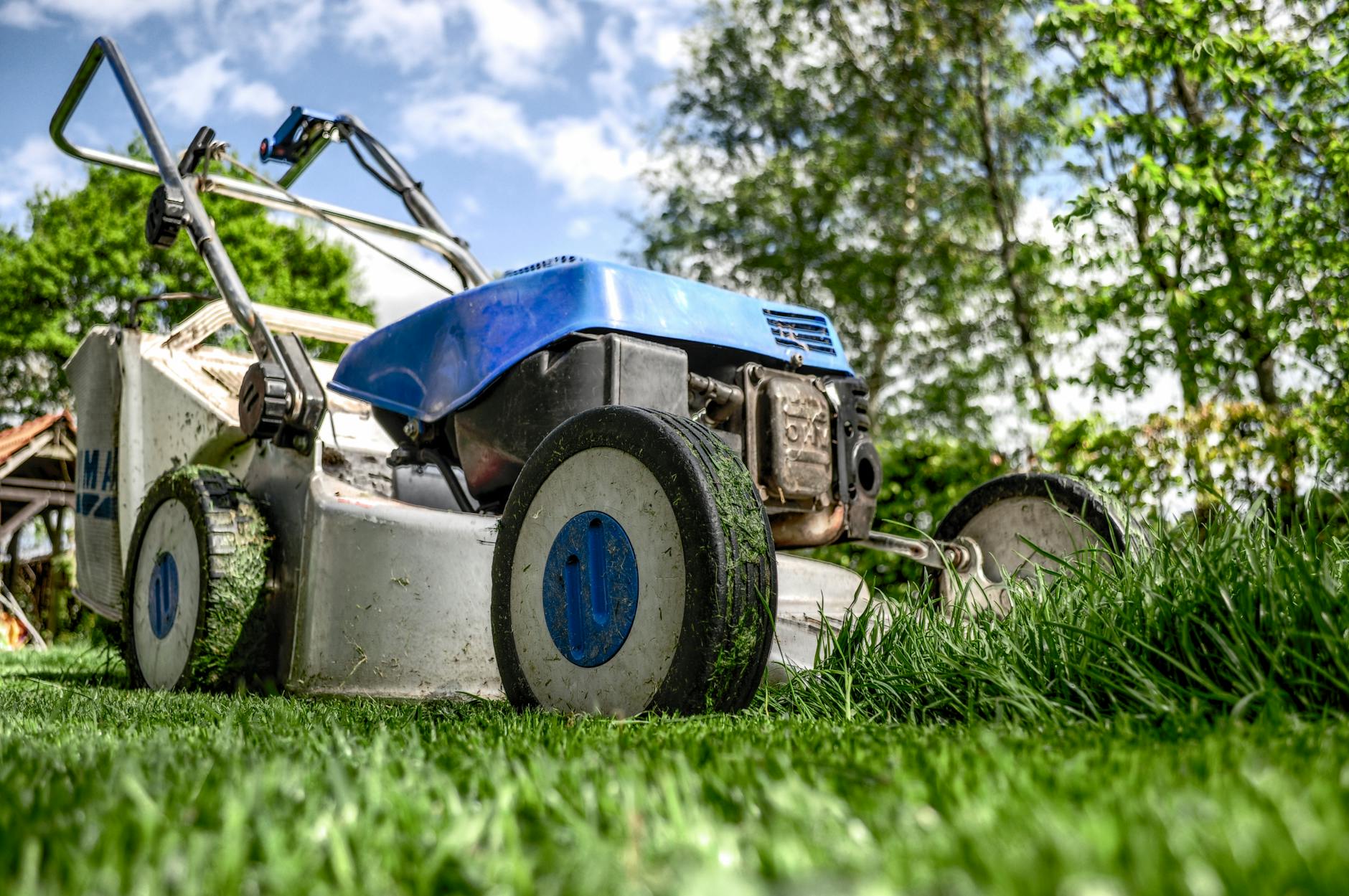
It all started in 1830, when that idiot, Edwin Beard Budding, invented the lawnmower.
Coveted by hoity-toity society to complement their ostentatious gardens, perfect grass became a symbol of pride―increasing their status, impressing strangers and one-upping their friends.
This tradition of landscaping lunacy still prevails. People pass by your property and turn up their noses if they spy unruly growth; you are a blemish on the neighborhood. (And if you’re one of those folks who has rusted car carcasses, tires, toilets and other junk strewn out front, I’m surprised it’s not punishable by death.)
My wife divorced me over our lawn―or lack of one. And I still have post- traumatic stress from the nagging.
“Are you going to mow the lawn? The grass is a foot high. What will people think?” And, of course, the umpteenth time she ordered me to water the lawn, and I told her to pray for rain.
When I bought my own house, I kept my grounds wild―untamed, uncut, untrimmed; my next-door neighbor didn’t mind. She was friendly, old and blind.
When she died, Fred and Laura moved in and hired a landscape architect. Some Frank Lloyd Wright type, modifying nature and charging thousands of dollars for it. Morons.
With no fence between our properties, it wasn’t long before my “eyesore” garnered vehement complaints.
I told Fred, “Look, untouched nature is beautiful, and two-inch-high grass is not normal, not to mention the 0.125-inch rule for those useless golf courses.”
Great. Fred was a golfer. And the wifey was already a member of the shishi poopoo local garden club that I didn’t even know existed.
Since I feared they would erect some ugly synthetic fence, I planted full-grown hedges, making a thirty-foot-long border. Okay. I couldn’t see my neighbors; they couldn’t see me. We’re good?
Apparently not. It blocked their sun, and according to the town ordinance #876, my hedges violated the height restriction. So instead of relaxing in my outdoor natural paradise, sipping cold juice and reading a book, I feverishly clipped the tops of my hedges to conform with town code and Fred’s policy of what nature should be. Okay, now we’re good?
Apparently not. Now that the hedges were shorter, Laura and Fred could see my “unsightly” yard from their second-floor windows. (Couldn’t they buy shades?) This time, Mr. Simmons from town hall made a visit. Armed with more ordinances, he issued me a junk citation and read aloud code #870. “Junk means all articles such as old appliances, pipes, mattresses…” He peered at me, continuing.
“And growing or harboring tall grass, straw or weeds.”
The town has a code that includes nature as junk? I retaliated. “Mr. Simmons,” I said. “Surely there is a noise ordinance.” I cited that seven days a week at 7 a.m. Fred mowed his lawn for forty-five minutes, then weed-whacked for another twenty. And every evening he performed a thirty-minute touch-up job.
“Vroom, vroom, vroom―even in the rain.”
“7 a.m. is a respectable hour,” said Mr. Simmons. “And I don’t consider the number of times excessive.
How else could Fred maintain such a perfectly manicured lawn?” Then he congratulated Laura on her prize-winning roses and for being elected Garden Club president.
The last straw was Fred and Laura’s outdoor gala honoring them with a national award for outstanding home landscaping. Through the hedges, I eavesdropped. “No, Laura didn’t invite her next-door neighbor.
The barbarian doesn’t even have a lawn, and he thinks weeds are beautiful!”
Their unbridled laughter galvanized me. Willingly hedged out of “normal” society, I sold my house, bought a 200-acre parcel in the deep woods of Maine and live happily in a one-room shack with a big dog, guns and no lawn. At the entrance of my property (if you can find it), I posted a massive sign:
Landscapers will be shot on sight!
 Little Old Lady Comedy