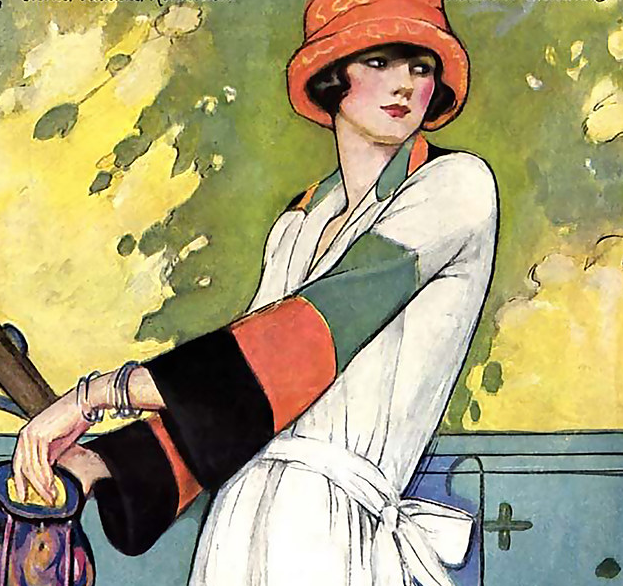
Word has it that over the course of several centuries the following events occurred, concerning the privileged female residents of Greenwich, Connecticut, one of the country’s toniest, most affluent, most status-conscious towns.
The first Real Housewife of Greenwich was Emily (Em) Osborne Polk, who in 1646, along with her husband, George, bought the land now known as Central Greenwich from native Americans for twenty-seven coats. She is said to have instructed her husband, “Darling, give them any one you want except my French-inspired high waistline with the split sleeves…it makes me look pounds thinner.”
The second Real Housewife of Greenwich was Barbara (Bar) Coevorden – wife of Stefan Aloysius, partner of the Polks – who in 1653, along with other Greenwichites, was accused by Puritans of receiving and harboring servants. “Really…is one expected to lace one’s own corset?!” she shouted from her balcony to her accusers.
In 1709, journeying by horseback, Sara Huntington – who was not a Greenwich housewife – complained about the mountainous incline on the east side of Greenwich. Real Greenwich Housewives were unsympathetic, scoffing, “What’s even more pitifulthan her riding is her choice of frock coat.”
After construction of the railroad in 1848 linking Greenwich to New York City, the town grew dramatically and, in turn, so did the number of Greenwich Housewives, since they could now have easy access to all that Manhattan had to offer without living anywhere near the riffraff. “I love spending a few hours a week in the city,” one Housewife is reputed to have whispered to another during their train ride into town. “The art galleries, the restaurants, Broadway…even that occasional walk among the hoi-polloi makes me feel so much closer to my maid.”
In 1884 a group of capitalists purchased land that became known as Belle Haven, and in 1889 residents of this luxury waterfront area founded The Belle Haven Club, which provided Greenwich Housewives with a place where they could meet, chat, lord it over one another, comfortably ensconced in, as one Housewife referred to it, “My mansion away from mansion.”
The Cos Cob Art Colony of Greenwich flourished in the early twentieth century, boasting as its most renowned member Pulitzer Prize winner Willa Cather who became famous for her realistic novels depicting frontier life on the Great Plains and, most especially, the plight of prairie females. When Ms. Cather was approached by several Greenwich Housewives and asked to write a novel about the plight of females in Greenwich, she is reported to have laughed uncontrollably.
In 1940, Lucille Ball and Desi Arnaz were married at The Hunt Club in the Glenville section of town. Scores of local women showed up to get a glimpse of, as one Real Greenwich Housewife put it, “Hair a shade of red never before seen in Greenwich, except perhaps on a decorated egg or two during our annual Easter Egg Roll.”
Greenwich Avenue, which represents the commercial and civic historical development of the downtown area, was listed on the National Register of Historic Places in 1989. With its ultra chic shops and restaurants, it is often referred to as the “Rodeo Drive of the East,” a comparison Real Greenwich Housewives resent, since they consider Rodeo Drive “vulgar, arriviste, and too pink.”
In 2001, the Supreme Court of Connecticut, citing freedom of assembly, forced the town of Greenwich to allow public access to its beaches – which had been previously open only to town residents and their guests. Though most of the Housewives of Greenwich use either their home pools or their clubs (or both) for swimming and sunning, they nevertheless occasionally prefer the experience of sand and surf, and were outraged at the idea of having to be in close proximity to semi-clad women with body mass indexes over 21.7.
 Little Old Lady Comedy