Let your hair down.
Let your clothes fall to the floor. Fall for a line.
Fall in value.
Fall on your back, fall on your knees, fall into the gutter. And look up. Sigh, heal, laugh, understand. Then rise.
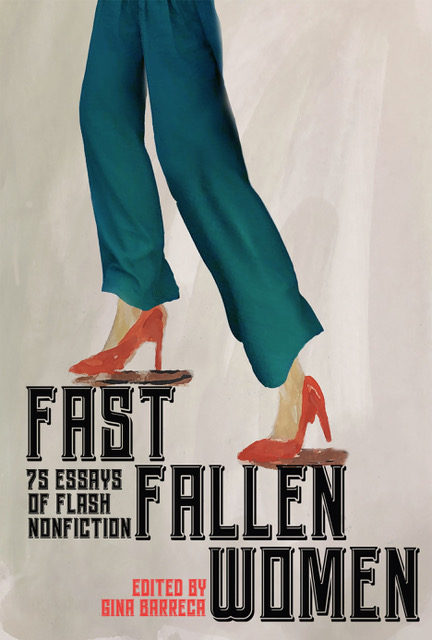
The fallen woman is in motion. She has a story. She’s usually kept it to herself. Not here. Through memoir, confession, humor, lived experience, professional discoveries, and intimate revelations, Fast Fallen Women gives whispered conversations a full voice.
Without fallen women, where would we be? Let’s start their literary history with motherless Eve in Eden, head through Milton in Paradise Lost, get into Kate from Taming of the Shrew (or Juliet in Romeo and Juliet, for that matter, who, as we recall, has sex with one man then dies), and swerve through Austen’s Lady Susan (and all the bitchy women in the rest of Austen’s books, not ignoring Austen herself, who once described the stillbirth of a neighbor’s child as occurring because the child happened to look at its father unawares), until we encounter the ur-fallen-woman of the modern era—1847, to be precise—Becky Sharp in Thackery’s Vanity Fair, be shocked still by Scarlett O’Hara in the Pulitzer Prize–winning (if racist) Gone with the Wind, see the success of Loos’s preferred blonde in Lorelei (who refuses to fall but can be pushy), learn what happens to women of color who also refuse to fall in Hurston’s Their Eyes Were Watching God, meet Gloria Wandrous, who literally falls in BUtterfield 8, see
Introduction
what happens to young women who might not fall but who wobble in Plath’s The Bell Jar, give sidelong glances at the girl who is all of age twelve at the beginning of Vladimir Nabokov’s Lolita, glimpse the emergence of women who engineer their falls for fun in Jong’s Fear of Flying, witness what punishments might happen to women who enjoy their falls too much if word gets around in Atwood’s The Handmaid’s Tale, learn how women triumph over their falls in Morrison’s Beloved, and celebrate the rise of women of Zadie Smith’s White Teeth. And that only takes us up to the start of the last century.
To get anywhere, a woman must fall. You can fall by being tipsy, get- ting ahead of yourself, by missing a step. You can fall because there was a blind alley, a sharp curve, a slippery surface, or a stumbling block. You fall because somebody pulls the rug out from under you or because the whole time as you stood, believing you were on solid ground, there was a trapdoor directly beneath you.
You might swoon, faint, trip, trip up, or get swept off your feet. You may be dumped, discarded, disregarded, been used up, or have been of no particular value in the first place.
You can fall because you were abandoned and then became a woman of abandon. Consider the word “abandon”: If you’re abandoned, you’re left behind, you’re emptied out; something or someone else comes in, the way it would into an abandoned building that was vacated and ripe for the next tenant.
But a woman of abandon? That’s something else. That’s where you’ve said, “I’m done. I’m not paying attention to what you told me, to all those rules telling me how I’m supposed to stay stable and good.”
FAST FALLEN WOMEN
And a woman who does something with abandon? It’s almost the same, but it has to do with something positive, not negative: It’s not just the release from restraint but the embrace of appetite. As if in reply to the sanctity of scarcity, she rejoices in the belief in abundance, in the idea that there is enough, or at least enough for now—and who knows what tomorrow will bring.
“Culpa” may mean “fall,” but it implies responsibility. A culpable woman is a capable woman, and an admission of guilt is the price of admission into a life of free will.
As soon as you feel your own desire, you fall. To feel deeply is to fall far. The fallen woman is controlling or out of control; she is out for herself or out of her mind; she is out for blood and out of bounds. A fallen woman is a dangerous woman because she has nothing left to lose.
Think of this collection of essays as a companion. Fallen women are often used as an object lesson, as the subject of a tutorial on how not to become her. This book is no such tutorial; it is a celebration. It encourages you to take risks. The risk of failure, rejection, humilia- tion—the risk of losing place for yourself entirely and not being able to get it back, of being seen as foolish, brazen, bitchy, grabby, and batshit crazy. Embrace the fall.
Printed with permission, Woodhall Press, from Fast Fallen Women edited by Gina Barreca (2023)
 Little Old Lady Comedy